S is for Sustenance
I recently read a rant about protein. It was funny, and it got me thinking.
The wellness industry took a real nutritional principle, wrapped it in plastic, and sold it back to us. Protein cookies. Protein chips. Protein pancakes.
And underneath the marketing, something quieter and more corrosive: the number. Some macro target you're supposed to hit, sourced from nobody's quite sure where, that you're already failing by 20 grams before noon.
I'm Julie Kaminski, a National Board-Certified Health & Wellness Coach, and I get the protein bully feeling. So let me say the annoying thing out loud:
Being right about the marketing doesn't make you right about the nutrient.
What is Sustenance in the SAVOR Method?
Sustenance is the S in the SAVOR Method, my five-pillar framework for midlife women (Sustenance, Activity, Variables, Organization, Refuelment). Sustenance covers how you fuel — approached as addition rather than restriction.
Why do women lose muscle in midlife?
Muscle loss in women is a two-stage problem. Muscle mass begins declining around age 30 at roughly 3 to 5% per decade, according to the Office on Women's Health. Then declining estrogen accelerates it, because estrogen is anabolic — it helps you build and hold muscle.
As estrogen falls, something called anabolic resistance sets in. Your muscle stops responding to the same protein dose the way it used to. The amount that flipped the switch at 30 doesn't reliably flip it at 55.
So it isn't one problem. It's a slow one you never noticed, and a fast one that arrived on top of it.
How much protein per meal do older women need?
The honest answer is that the direction is well supported and the exact number is not settled. Mechanistic research consistently finds younger adults reach near-maximal muscle protein synthesis around 20–25g of protein per meal, while older adults need closer to 35–40g for the same response.
But that's measured in a lab, over a few hours, looking at what muscle does right after a meal.
When researchers have run the longer version — put postmenopausal women on a strength program, fed one group noticeably more protein than the other, and measured months later — the higher-protein group hasn't reliably ended up with more muscle or more strength.
So: you've probably seen 1.6 to 2.0 grams per kilogram thrown around as settled fact. It isn't.
Which means the rant was right about the false precision. And still wrong about the conclusion.
Most women I work with aren't debating 1.6 versus 1.8. They're getting almost none until dinner.
How do I find out how much protein I'm actually eating?
Track what you normally eat for three days before you chase any target. Not a "good" three days — a real three days. Add up the protein.
Most women are surprised twice. Once by how low the total is. And again by where it's clustered.
Coffee. Maybe a piece of toast. A salad with a sad amount of chicken. Then 45 grams at 7pm, long after the day is over.
Is protein distribution more important than total protein?
For midlife women, distribution across the day likely matters as much as the daily total, because the body can't bank protein — a large dinner doesn't retroactively cover breakfast.
If the per-meal threshold is where the action is, three moderate anchors beat one enormous one. And breakfast is where almost every woman I know has the most room.
So the question isn't how do I hit my protein goal? It's where are my three anchors, and is breakfast one of them?
Three practical ways to get more protein
These are mine. They fit my mornings, my taste, my budget, and my willingness to do exactly one thing before coffee. Yours will look different, and they should. Steal what's useful.
1. Stacked water.
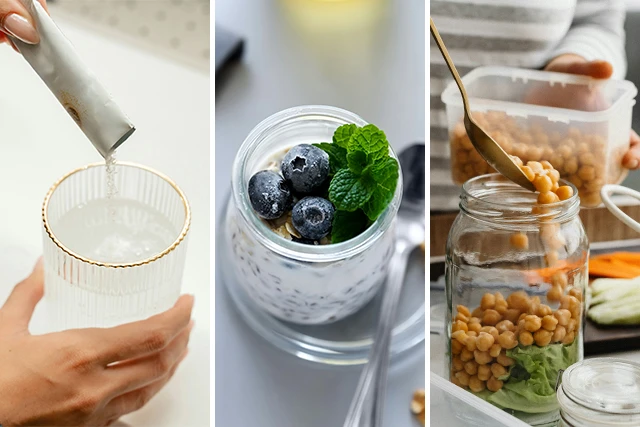
One bottle that does several jobs at once, so I'm not relying on remembering four separate things. Into a 64-ounce water bottle goes a Pure Genius protein shot, a packet of Thorne creatine, and a scoop of Vital Proteins collagen. Hydration, protein, creatine, and my supplement habit — one container, one decision.
Two caveats. Creatine degrades faster in acidic liquid, so I mix it the day I drink it rather than prepping a batch ahead. And Pure Genius was co-founded by Mel Robbins, which I mention because you deserve to know who makes what I recommend. It works for me. Do your own research.
2. The triple threat.
Nonfat Greek yogurt, a scoop of dry textured vegetable protein, a handful of berries. The TVP is the part people don't expect — dry soy granules with a Grape-Nuts texture, sprinkled straight on top, no rehydrating. It adds crunch and roughly 12 grams of protein per quarter cup, for 80 calories and no fat. Add about 17 grams from the yogurt and you're near 30 for the bowl.
3. Beans, lentils, legumes — on everything.
On salads. In soups. Under whatever's already on the plate. Three-quarters of a cup of lentils or chickpeas gets you 12 to 15 grams, plus fiber, plus a plant-based option that costs almost nothing. This is the least glamorous one and probably the most durable.
Does collagen count toward your protein target?
No. Collagen is a valuable supplement for skin, joints, and connective tissue, but it is an incomplete protein — it lacks tryptophan and is low in leucine, so it does almost nothing to stimulate muscle protein synthesis.
Take it for what it's good at, and don't let it pad your math.
Does soy affect estrogen levels in women?
Clinical evidence shows that soy foods and isoflavones do not alter circulating reproductive hormone levels in women. If you have a personal or family history that makes you cautious, ask your provider.
The real point
None of this is about hitting an arbitrary number so a stranger on the internet approves of your breakfast.
It's about having enough raw material to hold onto the muscle that carries you through the next thirty years.
This is addition, not subtraction.
The rant was right that the industry is selling you something. It's also true that you need this. Both things, at the same time.
And if you've been eating the way you always ate and quietly wondering what happened to your body — that was never a willpower problem. Nobody told you the rules changed.This is the work I do and love — helping women figure out what actually works for them, in their real kitchen, on their real Tuesday.
👉 Book a complimentary call and let's build yours.
Thriving isn't accidental. Thriving is intentional.
With warmth,
Julie
Julie Kaminski MA, NBC-HWC is a Board-Certified Health Coach and Founder of the SAVOR Method based in Charleston, South Carolina.
She holds a master’s degree with distinction in counseling psychology, is a graduate of the University of Pennsylvania’s Foundations of Positive Psychology certification, is NBC-HWC Certified, and maintains ACE Certifications in Group Fitness, Personal Training, and Fitness Nutrition. Whether coaching one-on-one, leading workshops, or designing group challenges, Julie’s mission is to help clients uncover their unique Blueprint to Thrive.
Answers to Frequently Asked Questions
How much protein should a woman over 50 eat per day?
There is no settled figure. Mechanistic research supports a higher per-meal dose than younger adults need, but longer trials in postmenopausal women have not reliably shown higher intakes outperforming the standard recommendation. Most women benefit more from evening out their distribution than from chasing a total.
What is anabolic resistance?
Anabolic resistance is a reduced muscle-building response to the same dose of dietary protein. It develops with age and is accelerated by declining estrogen, which is why a portion that was adequate at 30 may not be at 55.
Is textured vegetable protein healthy?
TVP is a defatted soy product providing roughly 12 grams of protein per quarter cup dry, with no fat and about 80 calories. It's a minimally processed, inexpensive way to add protein to foods you already eat.
Should I take creatine in midlife?
Creatine is among the better-studied supplements for muscle and strength, and interest in its use for midlife women is growing. Mix it the day you drink it, as it degrades faster in acidic liquid. Discuss supplements with your provider if you have kidney concerns.
Why is breakfast protein important for women in midlife?
Because protein can't be banked, each meal is a separate opportunity to stimulate muscle protein synthesis. Breakfast is typically the lowest-protein meal of the day for women, which makes it the easiest place to add.