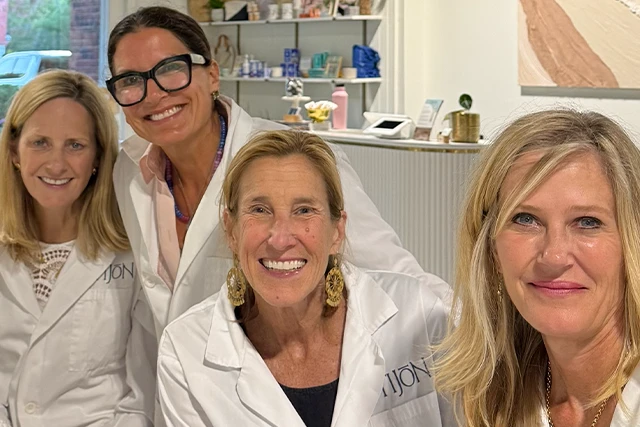
R is for Refuelment
We raised three kids in suburban New Jersey. Then we moved to Charleston, and I arrived without my queenager posse.
I remember the moment it landed: I was going to have to spend real energy on friendship.
Not hope for it. Not wait for it. Attend to it, the way you'd attend to anything else that matters.
I'm Julie Kaminski, a National Board-Certified Health & Wellness Coach, so I did what I do. I made it a strategy and gave it a goal — one social event a month for a year.
That lasted until my calendar filled up and I had to scale back to six. Which I'm choosing to count as the experiment working.
Why is it harder to make friends in midlife?
Friendship gets harder in midlife because the structures that used to generate it disappear at roughly the same time. For twenty years your rooms were built for you — the office, the school pickup line, the Saturday running group, the neighbors you'd known for years — and then those rooms thin out.
Kids leave, or the job you built your life around changes shape. Your closest friend moves somewhere warmer. Two of them are managing their parents' care.
Life changes.
You didn't get worse at friendship. The infrastructure that used to do it for you might have quietly disappeared.
Which means for the first time since you were about twenty-two, community is something you might have to build — or rebuild — on purpose.
Is loneliness actually a health risk?
Yes. The 2023 U.S. Surgeon General's advisory named social isolation and loneliness as independent risk factors for cardiovascular disease, dementia, depression, and premature death from all causes. That conclusion rests on research pooling data from more than 3.4 million people.
Independent risk factor.
That's the same language we use for blood pressure.
And here's the part that gets me. Researchers at BYU found that most people — including healthcare providers — still don't believe social connection meaningfully affects physical health. Even the clinicians who do recognize it say they lack the time or the tools to do anything about it.
If that sounds familiar, it should. It's the same gap we have around menopause training itself: real evidence, almost no one equipped to act on it.
Which means, once again, it's on us.
What does this look like in practice?
To be clear, your friendships do not need to become a support group with a laser focus on menopause. But it has been very nice to have a few close girlfriends who get vaginal atrophy and wrecked sleep.
We compare notes on our providers. What worked, what didn't, what we're going to go back and ask about. There's usually laughter, and usually a shared frustration that we lost decades of better menopause care while nobody was paying attention.
And we trade resources. This is the room where I told everyone: go find anything by Dr. Rachel Rubin. Listening to her talk about vaginal estrogen and women's health across the lifespan is equal parts empowering and infuriating.
Empowering because there are answers. Infuriating because the evidence isn't new — vaginal estrogen is the only non-antibiotic therapy with a Grade A recommendation for preventing recurrent UTIs in postmenopausal women, and one large study found it cut UTI frequency by more than half.
So why didn't my PCP mention that my recurrent UTIs might be connected to what's happening down there?
That's the kind of question that gets asked out loud in a good room. And it's the kind that never gets asked in a room where everyone is performing.
How do you build a friend group in midlife?
Be the one who invites. Everyone is waiting for someone else to go first. There's no shortage of women who want this — there's a shortage of women willing to send the text.
Make it recurring, not spontaneous. A standing date takes one decision. "We should get together sometime" takes twelve, and never survives the third reschedule. And you don't build trust in one long vulnerable evening — you build it by showing up to the same ordinary thing enough times that honesty stops feeling like a risk.
Keep it small. Four to six people. Big enough to survive someone cancelling, small enough that nobody performs.
Give it a shape. A walk, a book, a class, a table. Structure gives people something to do with their hands, and it lets the real conversation arrive sideways instead of on command. This is why walking works so well — nobody has to hold eye contact to say the hard thing.
None of that requires a retreat, a membership, or a personality transplant. It requires one text and a repeating calendar entry.
What is Refuelment in the SAVOR Method?
Refuelment is the R in the SAVOR Method, my five-pillar framework for midlife women (Sustenance, Activity, Variables, Organization, Refuelment). Refuelment covers rest, connection, and restoration — the inputs that replenish rather than deplete.
It's the pillar everyone assumes is the treat at the end. The bubble bath. The reward for doing the real work.
It can be. It's also structural. Positive relationships are one of the things that help you thrive.
I wrote more about the research behind this here: Why Social Health Matters.
What grew out of it
The concept of the SAVOR Society started to crystallize because it wasn't just that discussion.
The gatherings I'd put on the calendar kept turning into something bigger than what I'd scheduled them for. One of them — a multicultural discussion built around a single piece of art — got honest and vulnerable fast. That's where a seed was planted. I nurtured it.
And my clients kept saying the thing I'd been feeling myself: how am I supposed to thrive in a world that so often feels upside down?
So that's what the Society is. Each time we gather we take one element of SAVOR and sit with it — while fully acknowledging that life can be hard, and that pretending otherwise helps no one.
Not everyone who comes is a queenager, and that turns out to be the entire point. The reflection, the expansion, the integration — it moves generationally, in both directions, with real mutual respect.
Nobody's mentoring anybody. Everyone's mid-transition, just different ones.
It started as a goal on a calendar. It became something I didn't know I was building.
Our motto says it: thriving isn't accidental, thriving is intentional. And you shouldn't have to do the hardest recalibration of your adult life by yourself.
Come sit in the room.
The SAVOR Society is where this happens — real conversations, across generations, no performance required.
👉 Find out more — or follow along at @SAVOR_Society_Women
Thriving isn't accidental. Thriving is intentional.
With warmth,
Julie
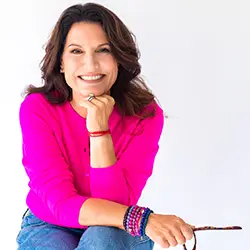
Julie Kaminski MA, NBC-HWC is a Board-Certified Health Coach and Founder of the SAVOR Method based in Charleston, South Carolina.
She holds a master’s degree with distinction in counseling psychology, is a graduate of the University of Pennsylvania’s Foundations of Positive Psychology certification, is NBC-HWC Certified, and maintains ACE Certifications in Group Fitness, Personal Training, and Fitness Nutrition. Whether coaching one-on-one, leading workshops, or designing group challenges, Julie’s mission is to help clients uncover their unique Blueprint to Thrive.
Answers to Frequently Asked Questions
Is loneliness as bad for your health as smoking?
The 2023 Surgeon General's advisory identified social isolation and loneliness as independent risk factors for cardiovascular disease, dementia, depression, and all-cause premature death, drawing on pooled data from more than 3.4 million people. The comparison to other major risk factors reflects that independent-risk status.
How many close friends do you actually need?
Research doesn't specify a number, but small groups tend to function better than large ones for genuine connection. Four to six people is large enough to survive cancellations and small enough that people don't perform.
Why do doctors not talk about loneliness?
BYU researchers found that most people, including healthcare providers, don't believe social connection meaningfully affects physical health. Clinicians who do recognize it commonly report lacking the time or tools to address it.
Does vaginal estrogen prevent recurrent UTIs?
Vaginal estrogen is the only non-antibiotic therapy carrying a Grade A recommendation for preventing recurrent urinary tract infections in postmenopausal women, and one large study found it reduced UTI frequency by more than half. Discuss it with your provider.
How do you make friends after 50?
Be the one who initiates, make gatherings recurring rather than spontaneous, keep the group small, and give it a structure — a walk, a book, a class, a shared table. Depth comes from repetition rather than from a single intense conversation.