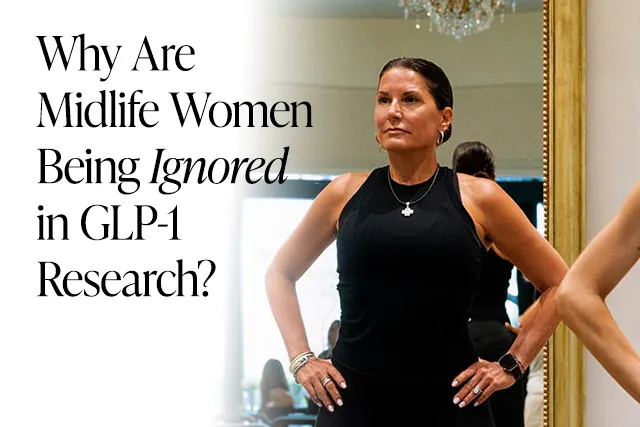
Why Are Midlife Women Being Ignored in GLP-1 Research?
Something is happening in the world of midlife women's health. And honestly?
It's about time.
I've been coaching women for decades — watching them white-knuckle their way through every wellness trend that promised to finally fix them. For years, I kept the conversation focused, steady, practical.
But the conversation is shifting. And I want you to feel it too.
What Are GLP-1 Medications?
GLP-1 receptor agonists (such as semaglutide/Ozempic/Wegovy and tirzepatide/Zepbound) are a class of medications originally developed for type 2 diabetes that are now widely prescribed for weight management.
They work by mimicking a gut hormone that regulates appetite, slowing digestion and reducing "food noise" — the constant mental chatter about eating. Brand names include Ozempic, Wegovy, Mounjaro, and Zepbound.
Who Is Actually Using GLP-1s for Weight Loss?
Women ages 50–64 are the number one users of GLP-1 medications for weight loss. We are the fastest-growing demographic. We are, in many ways, driving this entire conversation.
And yet — we are also the group most underrepresented in the clinical research on those same drugs.
We are the market. And we are still, somehow, an afterthought.
What Happened to the HRT Black Box Warning?
In February 2026, the FDA quietly removed the black box warning from hormone replacement therapy (HRT) — the warning that scared millions of women away from hormone therapy for over two decades, based on research that was later discredited.
Women suffered needlessly. Doctors under-prescribed. And when the correction finally came?
Barely a headline.
What Was the HRT Black Box Warning?
The black box warning on HRT was added in 2002 following the Women's Health Initiative (WHI) study, which suggested hormone therapy increased the risk of breast cancer and heart disease.
Subsequent analysis revealed the study's methodology was significantly flawed — participants were older, already at cardiovascular risk, and the findings were broadly misapplied to all women.
In February 2026, the FDA removed the black box warning, marking a major shift in how hormone therapy is understood and prescribed for menopausal women.
Is There a Connection Between HRT and GLP-1 Weight Loss Results?
Early observational data suggests women on hormone therapy who also take GLP-1 medications may lose significantly more weight than those on GLP-1s alone — with some studies pointing to up to 35% greater weight loss.
Researchers believe estrogen may enhance GLP-1's appetite-suppressing effects. Randomized controlled trials are currently underway.
Why Does Any of This Matter for Women in Midlife?
I find all of this both enlightening and infuriating in equal measure.
Enlightening because finally — finally — our health in midlife is being talked about openly, loudly, and without apology.
Infuriating because it took this long, and because there is still so much we simply don't know about how these medications interact with our changing hormones, our muscle mass, our metabolism.
What Is the SAVOR Method?
The SAVOR Method is a holistic health framework developed by Julie Kaminski, NBC-HWC, built around five pillars of sustainable wellbeing: Sustenance, Activity, Vitality, Organization, and Refuelment.
It is designed specifically to help women in midlife build lasting habits that support thriving in mind and body — with or without medication.
What Can Midlife Women Do Right Now?
Here's what I do know: the conversation has started. And I am adding my voice to it.
You deserve real information. Real talk. And a guide who isn't going to pretend any of this is simple.
That's exactly what I'm here for.
With warmth,
Julie

Julie Kaminski MA, NBC-HWC
Board-Certified Health & Wellness Coach
Founder of the SAVOR Method
Charleston, South Carolina
Website: JulieKaminski.com
Instagram: JulieKaminski
LinkedIn: JulieKaminski
P.S. I don't make blanket "drop everything and listen to this" recommendations lightly — ask anyone who knows me. But I'm making one now: find the Dr. Rachel Rubin, MD episode on The Mel Robbins Podcast ("The Ultimate Guide to Women's Sexual Health, HRT & Menopause," March 2026) and listen to it.
Then forward it to every woman you love.
Then maybe listen again.
Dr. Rubin is the friend we all deserved to have in our corner twenty years ago — and somehow didn't.
Answers to Frequently Asked Questions About GLP-1s, HRT, and Midlife Women's Health
What are GLP-1 medications and how do they work for weight loss?
GLP-1 receptor agonists (brand names include Ozempic, Wegovy, Mounjaro, and Zepbound) are a class of medications originally developed for type 2 diabetes that are now widely prescribed for weight management.
They work by mimicking a naturally occurring gut hormone that regulates appetite and blood sugar.
For many users, they significantly reduce "food noise" — the constant mental preoccupation with eating — making it easier to consume less without white-knuckling through hunger. They are not a cure. They work best when paired with lifestyle support including protein intake, resistance training, sleep, and movement.
Why are women 50–64 the biggest users of GLP-1s for weight loss?
Women in midlife experience significant hormonal shifts — declining estrogen, progesterone, and testosterone — that alter metabolism, increase central fat storage, and make traditional weight loss strategies less effective.
Many women in this age group have tried every approach and find that GLP-1s finally give them traction.
However, this demographic is also the most underrepresented in clinical research on these medications, meaning much of what we know about GLP-1 efficacy is based on studies that did not adequately include them.
What happens to your body when you stop taking GLP-1 medications?
When women — particularly postmenopausal women — stop GLP-1 medications without adequate lifestyle support in place, research suggests they often regain weight predominantly as fat rather than muscle.
This can leave them in a worse metabolic position than before starting the medication.
This is not a personal failure. It is a physiological response that underscores why sustainable habit-building — particularly resistance training and adequate protein intake — must run alongside any medication protocol, not after it.
What was the HRT black box warning and why was it removed in 2026?
The black box warning on hormone replacement therapy (HRT) was added by the FDA in 2002 following the Women's Health Initiative (WHI) study, which suggested hormone therapy increased the risk of breast cancer, heart disease, and stroke.
The warning caused a dramatic global drop in HRT prescriptions — by some estimates up to 80% — and left millions of menopausal women undertreated for symptoms including hot flashes, sleep disruption, bone loss, cognitive changes, and cardiovascular risk. Subsequent decades of research revealed that the WHI study's methodology was deeply flawed: participants were older, already at elevated cardiovascular risk, and the findings were broadly misapplied to all women regardless of age or health status.
In February 2026, the FDA removed the black box warning — a significant reassessment of HRT's risk-benefit profile for menopausal women. Most women, and many clinicians, are still unaware this change occurred.
Is there a connection between HRT and better results on GLP-1 medications?
Early observational data — including a notable study published in The Lancet Obstetrics, Gynaecology & Women's Health in January 2026 — suggests that women on hormone therapy who also take GLP-1 medications (specifically tirzepatide/Zepbound) may lose up to 35% more weight than women on GLP-1s alone.
Researchers theorize that estrogen may enhance GLP-1's appetite-suppressing effects. These findings are promising but preliminary — they come from observational studies, not randomized controlled trials. Randomized trials are currently underway.
This is an evolving area of research, and any decisions about combining HRT and GLP-1 therapy should be made in consultation with a qualified healthcare provider.
Should menopausal women consider hormone replacement therapy?
This is a question for your doctor — and specifically, a doctor who is up to date on the post-2002 evidence base.
The short answer is: the conversation has changed significantly. The removal of the black box warning in February 2026 reflects a major reassessment of HRT's risk profile. For many women, the benefits of hormone therapy — including protection against bone loss, cardiovascular support, symptom relief, and potentially enhanced response to weight management medications — may outweigh the risks.
The key is individualized assessment. Not every woman is a candidate, but far more women may be than previously thought.
If your doctor is still citing the 2002 WHI study as the primary reason not to pursue HRT, it may be worth seeking a second opinion from a menopause specialist.
What is the SAVOR Method and how does it support midlife health?
The SAVOR Method is a holistic wellness framework developed by Julie Kaminski, MA, NBC-HWC, built around five pillars of sustainable health and happiness:
- Sustenance (nourishing your body intentionally),
- Activity (movement as a daily practice, not punishment),
- Variables (protecting energy, sleep, and hormonal health),
- Organization (structuring your days with purpose), and
- Refuelment (rest, joy, and recovery as non-negotiables).
It is designed specifically for women navigating midlife transitions — including perimenopause, menopause, and post-menopause — who are tired of generic health advice that doesn't account for their full reality.
The SAVOR Method works independently of any medication and is designed to support lasting change whether or not a woman is using GLP-1s or hormone therapy.
What should midlife women know about muscle loss and weight management?
Postmenopausal women are at significantly higher risk for sarcopenia — age-related muscle loss — than younger women or men of the same age.
This matters enormously for weight management because muscle is metabolically active tissue: it burns calories at rest, supports insulin sensitivity, and protects long-term metabolic health.
When women lose weight rapidly — whether through caloric restriction, GLP-1 medications, or both — without prioritizing resistance training and adequate protein intake, a disproportionate amount of that weight loss can come from muscle rather than fat.
The practical upshot: resistance training and protein are not optional add-ons for midlife women. They are the foundation everything else is built on.
Where can I learn more about women's hormonal health and menopause?
One of the most accessible and medically rigorous resources currently available is the Dr. Rachel Rubin, MD episode on The Mel Robbins Podcast ("The Ultimate Guide to Women's Sexual Health, HRT & Menopause," March 2026).
Dr. Rubin is a urologist and sexual medicine specialist whose work focuses on closing the research and treatment gap for women's hormonal health.
The episode covers HRT, sexual health, menopause symptoms, and why so many women have been undertreated for decades. It is two hours and thirteen minutes long. It is worth every minute.
Have a question that isn't answered here? DM me "QUESTION" on Instagram @juliekaminski or contact me here — I answer every one.