



Why Weight Gain Happens in Menopause — Even When You’re Doing Everything “Right”
Menopause changed my metabolism—and my approach to a healthy weight.
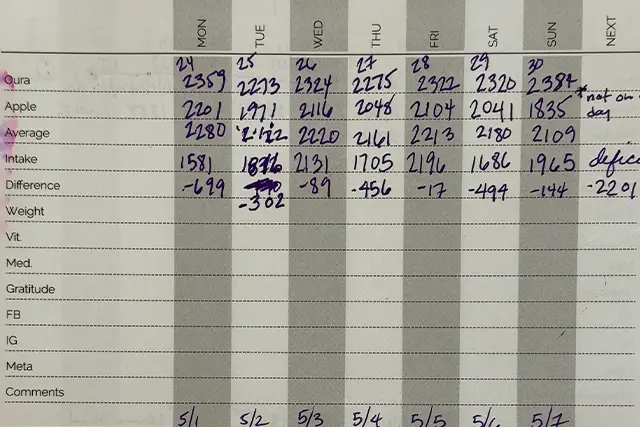
I still have the journal page. The journal page that should have worked.
It’s filled with numbers.
Calories burned from my Oura ring.
Calories burned from my Apple Watch.
An average of the two.
Calories consumed.
Daily calorie deficits calculated down to the decimal.
Yes — I tracked both biometric tools.
Yes — I averaged them.
Yes — I subtracted the difference.
If effort were the answer, that page should have worked.
But not much happened.
And that’s the part no one talks about.
A Moment Many Women Recognize
You might recognize this moment.
You’re doing the things that used to work.
You’re exercising.
You’re paying attention to nutrition.
You’re trying to take care of your health.
And yet something feels different.
The scale moves differently.
Your energy shifts.
Your body responds in ways that don’t quite match the effort you’re putting in.
That’s the moment many women quietly ask:
What changed?
I hear versions of this story from women almost every week in my coaching practice.
When Metabolism Changes
For decades we were taught a simple equation:
Calories in.
Calories out.
But menopause introduces new biological variables.
Hormones influence appetite signals.
Estrogen shifts impact fat distribution.
Muscle mass gradually declines.
Energy expenditure changes.
The result is a body that may respond very differently to the strategies that once worked.
What the Research Shows
Research increasingly shows that metabolism becomes more complex during midlife.
Hormonal shifts influence:
hunger signals
fat storage
muscle retention
energy expenditure
Which means the same behaviors may not produce the same results.
Menopause metabolism refers to the physiological shifts in hormones, body composition, and appetite regulation that influence weight and energy balance during perimenopause and menopause.
The Real Shift
For me, the most important realization wasn’t frustration.
It was curiosity.
Instead of asking:
“Why isn’t this working?”
I started asking a different question:
“What is my body trying to tell me?”
That question led me down a path I didn’t expect.
It led to research on metabolism and hormones.
It led to emerging conversations about GLP-1 medications.
It led to questions about personalized nutrition tools like microbiome testing and continuous glucose monitors.
And eventually, it led to a deeper realization about how health decisions actually work in real life.
Over the next few articles, I’ll share what that journey looked like—and what it revealed about the changing rules of health in midlife.
A Conversation for Women Navigating Midlife Health
If you’re navigating questions about metabolism, behavior change, or thriving in midlife, these are conversations I explore regularly with clients.
I invite you to book a free consultation with me here.
With warmth,
Julie

Julie Kaminski MA, NBC-HWC
Board-Certified Health & Wellness Coach
Founder of the SAVOR Method
Charleston, South Carolina
Website: JulieKaminski.com
Instagram: JulieKaminski
LinkedIn: JulieKaminski
Why does weight gain happen during menopause?
Does tracking calories stop working in midlife?
The Midlife Metabolism Series
Perimenopause and menopause bring profound changes to metabolism, hormones, and body composition. Many women find that the strategies that supported their health for decades suddenly stop working as effectively.
In this four-part series, board-certified health coach Julie Kaminski explores the science and lived experience behind midlife metabolic change, from menopause weight gain to GLP-1 medications, precision nutrition tools, and the realities of individual variability.
Together, these articles explore a central question:
How can women support a thriving mind and body when the biological rules begin to shift?
Articles in this series will include:
- Why Weight Gain Happens in Menopause — Even When You’re Doing Everything Right
- When Science Changed My Mind About GLP-1 Medications
- Before You Mail Your Poop and Pop on a Glucose Monitor
- When Precision Nutrition Meets Real Life
Stay tuned for more articles in this series.